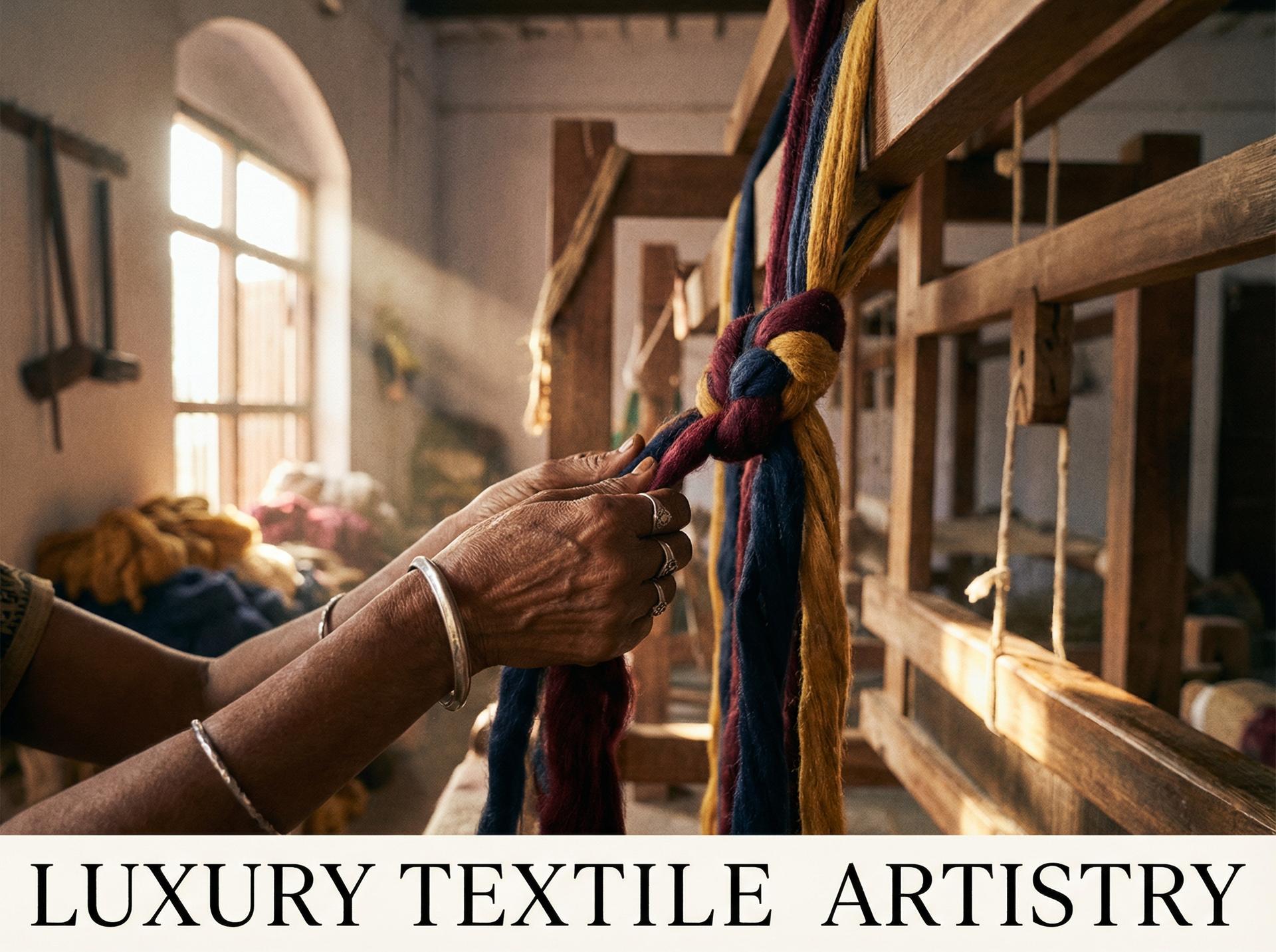
In the quiet workshops of Bhadohi, India, a tradition spanning five millennia continues to thrive. Here, skilled artisans sit before vertical looms, their fingers moving with practiced precision as they tie knot after knot, creating rugs that are not merely floor coverings but works of art that will last for generations.
The Origins of Hand-Knotting
The art of hand-knotting rugs is believed to have originated in Central Asia around 3000 BCE. Nomadic tribes developed this technique to create durable, portable floor coverings that could withstand harsh climates while providing warmth and comfort. The oldest known hand-knotted rug, the Pazyryk carpet dating from the 5th century BCE, demonstrates that even our earliest ancestors understood the value of this meticulous craft.
Over centuries, the technique spread along the Silk Road, with each region developing its own distinctive patterns, colors, and knotting methods. From the geometric designs of Persia to the floral motifs of India, hand-knotted rugs became expressions of cultural identity and artistic achievement.
The Knotting Process
Creating a hand-knotted rug is an exercise in patience and precision. Each rug begins with the warping of a loom, where vertical cotton or wool threads are stretched taut to form the foundation. The weaver then works row by row, tying individual knots around pairs of warp threads, cutting each knot to create the pile, and compacting the rows with a heavy comb.
At Eastern Mills, our master weavers typically achieve between 100 to 200 knots per square inch, though some exceptional pieces may feature even higher densities. A single 9x12 foot rug with 150 knots per square inch contains over 23 million individual knots, each tied by hand. Such a rug may take a skilled artisan 18 to 24 months to complete.
The Two Primary Knot Types
The Persian (Senneh) Knot: This asymmetrical knot wraps around one warp thread and passes under the adjacent thread. It allows for finer detail and is preferred for intricate curvilinear designs.
The Turkish (Ghiordes) Knot: This symmetrical knot wraps around two adjacent warp threads, creating a more durable pile. It is ideal for geometric patterns and produces a slightly coarser texture.
The Artisans Behind the Craft
At Eastern Mills, we work with over 3,000 skilled artisans across the Bhadohi region, many of whom represent the third or fourth generation of their families to practice this craft. Our weavers undergo years of training, beginning as apprentices who learn color theory, pattern reading, and the fundamental knotting techniques before progressing to more complex designs.
We believe in preserving not just the technique but the spirit of this craft. Our artisans work in well-lit, comfortable conditions and receive fair compensation that honors the extraordinary skill their work represents. Many of our master weavers have been with us for decades, their expertise contributing to the exceptional quality that defines Eastern Mills rugs.
Why Hand-Knotted Rugs Endure
In an age of mass production, hand-knotted rugs stand as testament to the enduring value of human craftsmanship. Each rug carries the unique touch of its maker, subtle variations in tension and color that give the piece character and soul. These are not products manufactured to specifications but creations born of patience, skill, and artistic vision.
A well-made hand-knotted rug will outlast its owner, often improving with age as the wool softens and the colors develop a gentle patina. Many hand-knotted rugs from previous centuries remain in excellent condition today, cherished as family heirlooms and displayed in museums worldwide.
Preserving the Future
At Eastern Mills, we are committed to ensuring that this ancient craft continues to flourish. Through training programs, fair trade practices, and ongoing investment in our artisan communities, we work to create sustainable livelihoods that make traditional rug making an attractive career for younger generations.
When you choose a hand-knotted rug, you become part of this continuing story, supporting a living tradition that has enriched human life for five thousand years and will continue to do so for millennia to come.


